Stop Smoking Service
Friendly, expert support and treatments to help you quit smoking for good — free through the NHS.
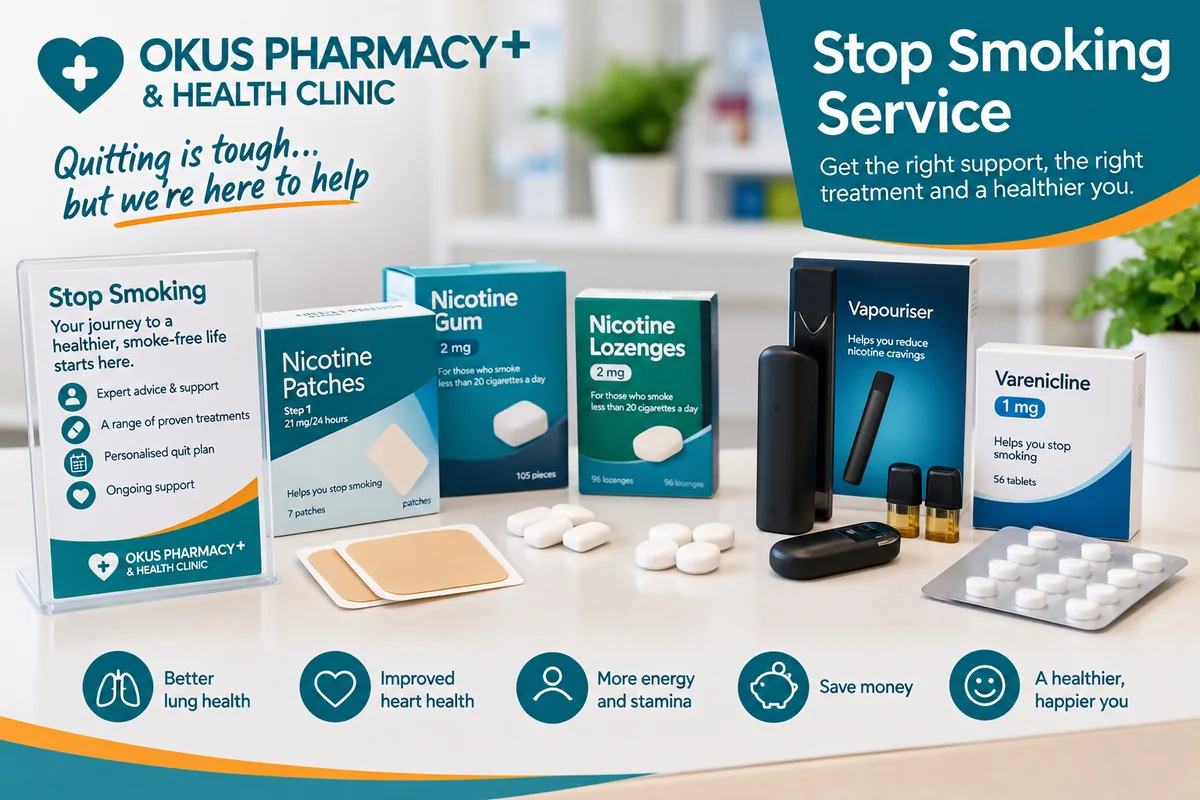
Our Stop Smoking Service gives you the support and treatment you need to quit for good. Stopping smoking is one of the best things you can do for your health — and with expert help you are up to three times more likely to succeed than by willpower alone.
Our trained pharmacist will work with you to build a personalised quit plan, offering friendly, non-judgemental support and regular check-ins to keep you on track. Where appropriate, we can supply nicotine replacement therapy (NRT) such as patches, gum, lozenges, and inhalators to help manage cravings and withdrawal.
This service is available free of charge through the NHS for eligible patients. Whether it is your first attempt or you have tried before, we will support you at every step towards becoming smoke-free.
Key Features
- Free NHS service for eligible patients
- Personalised quit plan with regular support
- Nicotine replacement therapy (NRT) supplied where suitable
- Friendly, non-judgemental pharmacist support
- Up to 3x more likely to quit with expert help
Why quit
What happens when you stop smoking
Your body starts to repair itself almost as soon as you stop — and the benefits keep building. As well as better lung and heart health, more energy, and the money you save, here is roughly what happens after your last cigarette:
Your pulse rate and blood pressure begin to return to normal.
The nicotine and carbon monoxide in your blood fall by around half, and oxygen levels start to return to normal.
Carbon monoxide has cleared from your body and your lungs start to clear out mucus.
There is no nicotine left in your body, and your sense of taste and smell improve.
Breathing feels easier and your energy increases.
Your circulation improves, making walking and exercise easier.
Coughing and wheezing ease as your lung function improves by up to 10%.
Your risk of a heart attack falls to about half that of a smoker.
Your risk of lung cancer falls to about half that of a smoker.
It is never too late to benefit — stopping smoking improves your health at any age, however long you have smoked.
Your options
Treatments that can help you quit
There is no single “best” way to quit — the right approach is the one that works for you. Using a stop smoking treatment together with our support gives you the best chance of success. Options that may be offered include:
Nicotine replacement therapy (NRT)
Nicotine — no tar or smoke- Gives you nicotine without the harmful tar and carbon monoxide in cigarettes, easing cravings and withdrawal.
- Available as patches (e.g. 21mg/24hr), gum (e.g. 2mg), lozenges (e.g. 2mg), inhalators and mouth or nasal sprays.
- Using a patch plus a faster-acting form such as gum or lozenges often works best.
Stop smoking tablets
Nicotine-free — prescription only- Nicotine-free medicines such as varenicline and cytisine work on the brain to reduce cravings and make smoking less enjoyable.
- Taken as a short course of tablets started before your quit date, and supplied only after a suitability check.
- Not suitable for everyone — for example during pregnancy; your pharmacist will advise.
Vaping (e-cigarettes)
An effective quit aid- Vaping is substantially less harmful than smoking and is one of the most effective aids to quitting.
- It delivers nicotine as a vapour to manage cravings while you break the smoking habit.
- It is intended for adult smokers who want to quit — not for people who have never smoked.
Not every option is suitable for everyone, and availability can vary — your pharmacist will talk through the choices and recommend what is right for you.
Your quit plan
What to expect from the service
Your pharmacist works with you from your very first appointment through to becoming smoke-free. Here is what is involved:
- A friendly, non-judgemental chat about your smoking, any previous quit attempts and what tends to trigger you
- Setting a quit date — most people do best picking a day and stopping completely, rather than cutting down slowly
- Choosing the treatment that suits you, and being shown how to use it correctly
- Regular check-ins to keep you motivated and adjust your plan — sometimes with a simple breath test (a carbon monoxide monitor) to show your progress
- Ongoing support, usually for around 12 weeks — and if you slip up, we will help you get straight back on track
Good to know
Tips to help you stay smoke-free
- Write down your reasons for quitting and keep them where you will see them
- Clear out cigarettes, lighters and ashtrays before your quit date
- Change your routine to avoid triggers — such as the after-meal cigarette or your usual smoking spot
- Keep your hands and mouth busy — sugar-free gum, a drink of water, or an NRT product
- Tell friends and family so they can support you, and team up with others who are quitting
- Remember cravings are temporary — most pass within a few minutes
- Put the money you would have spent aside and treat yourself
- If you slip, don’t give up — learn from it and carry on
Getting the right advice for you
Stopping smoking is safe and hugely beneficial. A few things are worth mentioning so we can tailor your plan:
- Tell us if you are pregnant or breastfeeding — quitting is especially worthwhile then, and we will recommend the safest options for you and your baby
- Let us know about your regular medicines — stopping smoking can change how some work (for example certain medicines for asthma, mental health, diabetes or blood thinning), so a dose review is occasionally needed
- Mention any mental health conditions — support can be tailored, and for many people quitting improves mood and anxiety over time
Whatever your situation, our pharmacist will talk it through with you. You can also find free NHS quit tools and support through Better Health on nhs.uk.
Good to know
Frequently asked questions
Is the service really free?
Yes. Our NHS stop smoking support is free for eligible patients, and NHS stop smoking medicines are provided without the usual prescription charge under the service. Your pharmacist will confirm exactly what is included for you.
Do I need a referral from my GP?
Not usually — you can come to us directly. Just book an appointment or call us and we will get you started.
Which treatment is best?
There is no single best option. What matters most is using a treatment you get on with, together with regular support — this makes you far more likely to succeed than willpower alone. Your pharmacist will help you choose.
Will I get withdrawal symptoms?
You may notice cravings, irritability, restlessness or trouble sleeping in the first few weeks. These are temporary and are exactly what stop smoking treatments are designed to ease. Individual cravings usually pass within a few minutes.
Can I use a vape to quit?
Yes. Vaping is substantially less harmful than smoking and is an effective way to quit. It is intended for adult smokers who want to stop — if you have never smoked, vaping is not recommended.
What are stop smoking tablets like varenicline?
Varenicline and cytisine are nicotine-free tablets that reduce cravings and make smoking less satisfying. They are taken as a short course started before your quit date, and are only supplied after a suitability check. They are not suitable for everyone.
Can I stop smoking if I am pregnant?
Yes — and it is one of the best things you can do for you and your baby. Some treatments are not suitable in pregnancy, so we will recommend the safest approach and can arrange extra support.
What if I slip up and have a cigarette?
Do not be discouraged. A slip does not mean you have failed — it is very common. Tell us what happened and we will help you learn from it and carry on. Most people who quit have tried more than once.
Written and clinically reviewed by Tanvir Ali, MPharm — Superintendent Pharmacist & Owner. Okus Pharmacy & Health Clinic is a GPhC-registered pharmacy. Meet our pharmacist.
Last reviewed: August 2026. This page provides general health information and is not a substitute for personalised medical advice — please speak to our pharmacist about your individual circumstances.
Other Services
Travel Vaccination Clinic
Stay protected wherever you travel. Expert advice and a comprehensive range of travel vaccines available.
PrivateVitamin B12 Wellness Clinic
Boost your energy and support your wellbeing with our professional B12 injection service.
PrivateWeight Loss Clinic
Personalised support and treatments to help you achieve your weight loss goals.